Post-collapse ecological loss and renewal
The Dog StarsPost-collapse ecological loss and renewal is the book’s account of a damaged natural world that neither disappears all at once nor simply recovers. Warming and drought steadily alter streams, forests, and animal ranges; familiar species vanish, and the water that sustains human and nonhuman life becomes precarious. Against this attrition, pockets of green growth and returning wildlife offer evidence of persistence, but not a restoration of the world Hig remembers. The contrast makes ecological change a force in its own right: a cause of practical danger, a source of grief, and a limit on what survival can mean.
A world changing by degrees
The ecological crisis unfolds through accumulating changes rather than one clean break. In mid-April, Hig finds the old seasonal benchmarks unreliable: the mountains have had snow, but in two successive years the peaks were nearly bare. This alarms him more than attacks or disease. His fear is grounded in a larger pattern of warming and prolonged dryness, not in a single dramatic disaster. The loss of the Trout is already a sign that conditions in the water have crossed a threshold; losing the creek itself would mean something more fundamental.
Water under pressure
At Cima’s canyon home, drought is a direct threat to people and livestock. The previous summer the creek nearly dried up, and the family had to dig in its bed to gather enough water to drink. Half the Cattle died. The account connects these immediate hardships to a worsening pattern: temperatures rise, and each year seems drier than the last. The green meadow and running stream, seen at first as evidence of refuge, cannot guarantee continued safety.
Hig sees the same pressure in the creek’s early, rapid decline. The water level drops perceptibly from day to day, exposing the creek bed; stones stand out, and logs and debris remain propped above the shrinking flow. He fears that if the stream dries, not only fish able to tolerate warmer water, including Carp and catfish, but also crawfish and frogs will die. Even the Carp, which had occupied the niche left by the vanished Trout, are later found skinny and starving. Their condition suggests that adaptation to warmer water has not made them secure: the changing system is affecting the new occupants as well.
Extinction, memory, and place
For Hig, the disappearance of the Trout is more than the loss of a food source or a favorite pastime. He once loved fishing them above all else, and remembers particular creeks as places where he felt at home in the landscape. The dead forest, the surviving green woods, deer beds, and the hope of seeing a single fish give his account of ecological damage a precise local scale. Fishing becomes a way to return to places he knows, even as the conditions that made them familiar are changing.
When Trout are gone, Hig continues fishing in the mountains, taking Suckers and Carp instead. He learns to eat the unfamiliar catch, though its sluggish resistance and different taste and bones make the substitution plain. Carp move into the vacant niche and feed more often at the surface, so he sometimes fishes with dry flies. Yet this change is not presented as an equivalent replacement. Later, after catching five thin Carp, Hig handles them with the care he had once reserved for Trout, holds them in the current until they can swim away, and stops fishing. His grief extends beyond one species: he thinks of the lost Trout, Elk, tigers, elephants, and Suckers, and fears that even the Carp may disappear.
Fires, ruined cities, and animal movement
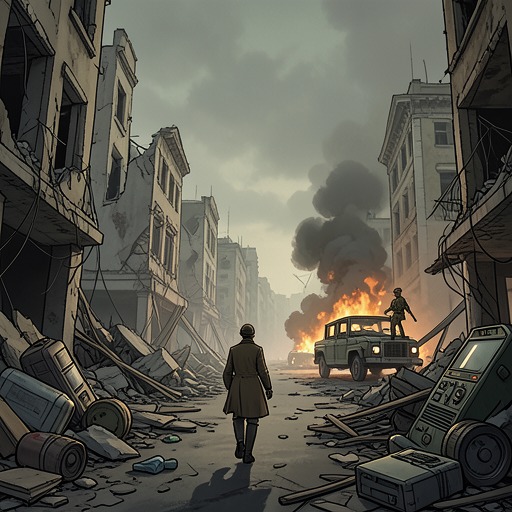
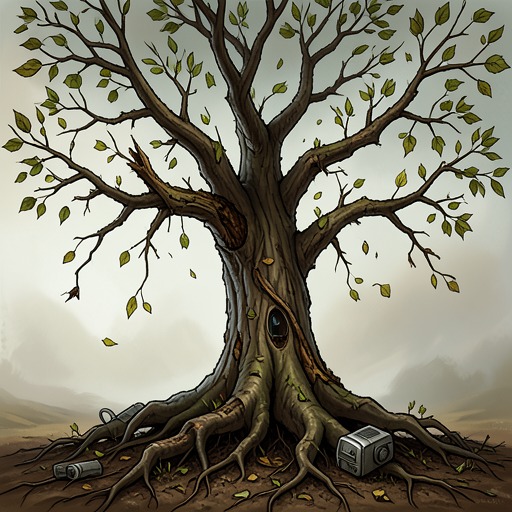
Ecological damage is visible alongside the wreckage of human society. In Grand Junction, some of the oldest cottonwoods still shade the river parks, though drought has left several half-dead and leafy on only one side. Elsewhere, city blocks and neighborhoods have burned; human bones lie scattered or gathered in heaps. The image of a few surviving trees amid a devastated city does not make the place whole. It sets limited endurance against destruction on a scale that reaches both human settlement and the living landscape.
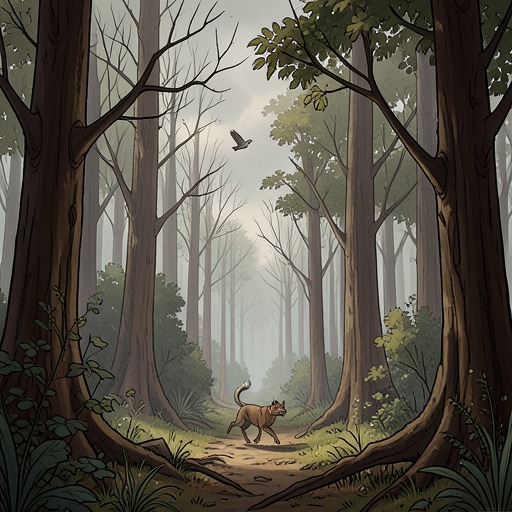
On a later flight, the view offers a more complicated picture. Three Bison graze at the end of a runway. Hig observes that Bison are moving down toward their old range, as are Wolves and Bighorn sheep, while Trout and Elk are gone. Osprey and Bald eagles have appeared near Jasper’s creek; mice and hawks remain plentiful, and crows fill the winter trees. Miles of forest are dead, yet Spruce, fir, and aspen are coming back. These observations mark movement and regrowth, but they do not add up to a simple return: some species are absent, others are shifting range, and new growth occupies a landscape still marked by extensive loss.
The flight also passes a vast fire near Kremmling, apparently new and started by lightning. Trees at its edge catch and burst into flame, and Deer run downhill. A Grizzly bear follows, trying to herd two cubs away from the fire; Deer are also swimming in the river above the canyon. Hig recalls a museum painting of dinosaurs fleeing across a plain as fire and volcanoes erupt. The comparison places the animals’ flight within a long, unsettling image of life forced onward through upheaval. It does not make the animals mere symbols: the bear’s effort to guide her cubs and the Deer’s movement are immediate events in a changing habitat.
Partial renewal and its limits
The landscape’s returns are real but incomplete. Green trees survive among dead ones, and Spruce, fir, and aspen begin growing again. Bison, Wolves, and Bighorn sheep move toward old ranges; birds of prey are present near the creek. Such signs resist the idea that the world has become wholly lifeless, while the vanished Trout, missing Elk, falling water, and repeated fires resist any claim that it has recovered. Renewal appears as a local, uneven process, not a restoration that cancels what is gone.
Cima’s reaction to the landscape beyond the canyon sharpens this uncertainty. Looking out at the empty, burning world, she remains in shock; for Hig, even intact buildings seem unnerving because they look almost normal. The contrast between apparent continuity and profound change runs through the ecological account as well. A green meadow can coexist with a creek on the verge of drying, and returning trees with miles of dead forest. The book treats these as conditions with consequences for human life, but gives the nonhuman losses their own weight: the vanished species, altered waters, and damaged places matter beyond their usefulness to survivors.